目錄
Today’s post is not a Japanese lesson. Instead, we are taking a closer look at Japanese license plates.
I have always been curious about how Japan assigns license plate numbers and street addresses. Every time I see one, I try to work out the system behind it, only to realize that it is much more complicated than it looks. So naturally, I ended up going down a research rabbit hole.
In Japanese, a license plate is commonly called a ナンバープレート (nanbā purēto, from the English term “number plate”). Its official name, however, varies depending on the type of vehicle:
- 自動車登録番号標(じどうしゃとうろくばんごうひょう/jidōsha tōroku bangōhyō)
- 車両番号標(しゃりょうばんごうひょう/sharyō bangōhyō)
- 標識(ひょうしき/hyōshiki)
Under Japan’s Road Transport Vehicle Act, or 道路運送車両法(どうろううんそうしゃりょうほう/Dōro Unsō Sharyō-hō):
- A 自動車登録番号標 is used for standard-sized vehicles, including vehicles with an engine displacement of more than 2,000 cc, compact vehicles and large special-purpose vehicles.
- A 車両番号標 is used for kei vehicles with an engine displacement of 660 cc or less, as well as motorcycles in the 125 cc and 250 cc categories.
- A 標識 is primarily used for very small vehicles and motorcycles with an engine displacement of 125 cc or less.
How Did Japanese License Plates Develop?
Japan’s first automobiles appeared during the Meiji period, which lasted from 1868 to 1912. At the time, only wealthy people could afford or were permitted to drive.
Cars were already travelling on public roads, but there were no traffic lights and vehicles did not carry license plates. As traffic accidents became more frequent, Japan began requiring automobiles to display registration numbers in 1907.
The earliest license plates were extremely simple. They consisted of only four Arabic numerals and were mainly used to identify the vehicle’s owner.
During the Taishō period, location names were added to the four-digit registration numbers.
In 1913, areas outside Tokyo were represented by the first Roman letter of their prefecture or municipality. This system quickly became confusing, so the Roman letters were replaced with kanji characters in 1919.
For example:
- 京 represented Kyoto Prefecture.
- 神 represented Kanagawa Prefecture.
- 愛 represented Aichi Prefecture.
Tokyo was treated differently because it was the national capital. Its plates continued to display only four Arabic numerals.
In March 1955, Japan introduced a license plate design that was almost identical to the system used today, excluding kei cars and motorcycles.
When multiple prefectures or registration areas shared the same kanji character, the most populous area was allowed to use the first character, while other areas displayed their full names.
From January 1988 onward, registration areas for vehicles other than kei cars were written using their full names.
The classification code, known as the 分類番号(ぶんるいばんごう/bunrui bangō), originally consisted of only one digit. Following a partial revision of the Road Transport Vehicle Act enforcement regulations in October 1967, the system gradually shifted to two-digit codes.
Three-digit classification codes were introduced in selected regions in May 1998 and adopted nationwide in May 1999. Kei vehicles began using three-digit classification codes in January 2005.
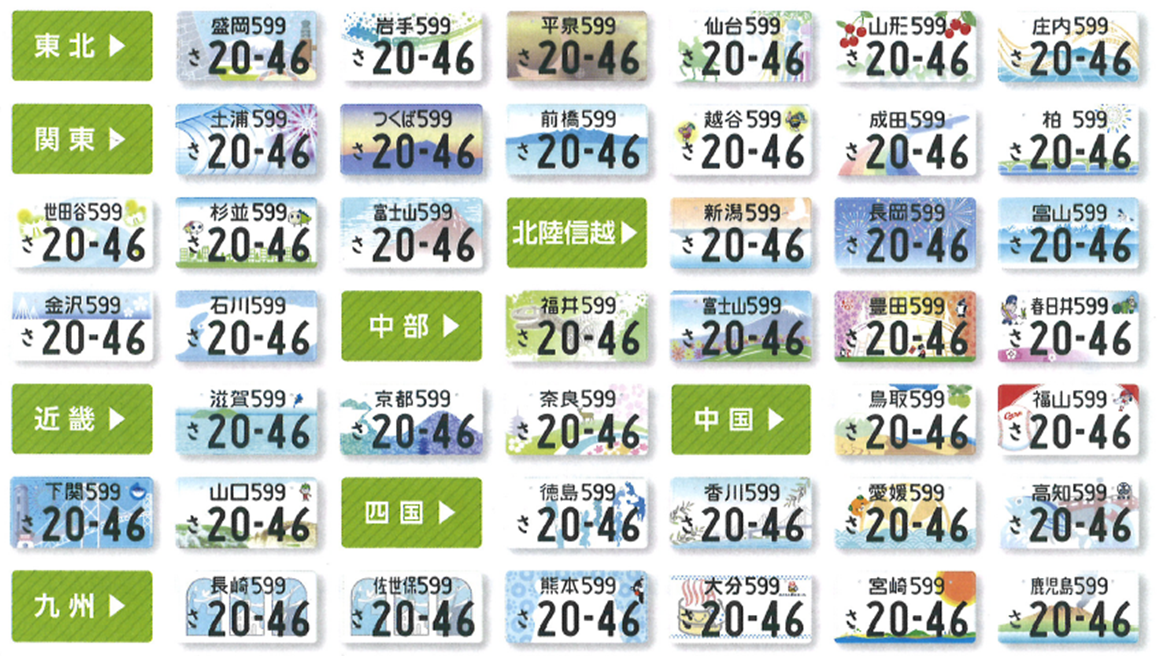
In 2006, Japan introduced the ご当地ナンバー(gotōchi nanbā), or regional license plate, system to promote regional identity and tourism.
These special license plates feature registration-area names and designs connected to local culture, landscapes and attractions. To date, 116 different regional plate names have been issued.
What Do Japanese License Plates Look Like?
Japanese license plates can mainly be classified according to two features:
- Plate size
- Plate color
License Plate Sizes
Large License Plate
The official Japanese name is 大型番号標(おおがたばんごうひょう/ōgata bangōhyō). It is commonly called an 大板(おおばん/ōban), meaning “large plate.”
- Size: 440 mm wide × 220 mm high
- Aspect ratio: 2:1
- Installation: secured with two bolts at the top and two at the bottom
Large plates are required for vehicles that meet one or more of the following conditions:
- A gross vehicle weight of more than eight tonnes
- A maximum payload of more than five tonnes
- A passenger capacity of more than 30 people
Medium License Plate
The official Japanese name is 中型番号標(ちゅうがたばんごうひょう/chūgata bangōhyō). It is commonly called a 中板(ちゅうばん/chūban), meaning “medium plate.”
- Size: 330 mm wide × 165 mm high
- Aspect ratio: 2:1
- Installation: secured with two bolts along the top
Vehicles that do not fall into the large-plate or small-plate categories generally use a medium-sized license plate.
Small License Plate
The official Japanese name is 小型番号標(こがたばんごうひょう/kogata bangōhyō). It is commonly called a 小板(しょうばん/shōban), meaning “small plate.”
- Size: 230 mm wide × 125 mm high
- Aspect ratio: approximately 1.84:1
- Installation: secured with two bolts along the top
This plate is used for light motorcycles, small motorcycles and certain other light vehicles.
License Plate Colors
With the exception of kei vehicles first registered from January 1975 onward, standard Japanese license plates are mainly divided into the following categories.

- Privately owned automobiles
- Privately owned motorcycles have an additional green border

- Commercial vehicles
- Commercial motorcycles have an additional white border
Kei vehicles first registered from January 1975 onward use a different color system.


These make up the six license plate designs most commonly seen on Japanese roads.
The following four categories of special vehicles use their own distinctive plate designs:
- Vehicles used by the Imperial Household Agency
- Japan Self-Defense Forces vehicles
- Diplomatic vehicles administered through the Ministry of Foreign Affairs
- Vehicles belonging to United States Forces Japan
Understanding the Classification Code
The 分類番号(ぶんるいばんごう/bunrui bangō)is the three-digit number displayed next to the registration-area name.
The first digit indicates the vehicle’s registration category.
- Codes beginning with 1: Standard-sized freight vehicles with an engine displacement above 2,000 cc
- Codes beginning with 2: Standard-sized passenger vehicles
- Codes beginning with 3: Standard-sized passenger cars with an engine displacement above 2,000 cc
- Codes beginning with 4: Compact freight vehicles between 660 cc and 2,000 cc
- Codes beginning with 5: Compact passenger cars between 660 cc and 2,000 cc
- Codes beginning with 8: Special-purpose vehicles above 660 cc
- Codes beginning with 9: Large special-purpose vehicles
- Codes beginning with 0: Construction machinery
Hiragana and Roman Letters on Japanese License Plates
On the lower-left side of a Japanese license plate, you will usually see a single hiragana character or Roman letter.
This character indicates how the vehicle is registered and what it is used for.
Standard Registered Vehicles
White Background with Green Lettering
Privately Owned Vehicles
さ・す・せ・そ・た・ち・つ・て・と・な・に・ぬ・ね・の・は・ひ・ふ・ほ・ま・み・む・め・も・や・ゆ・ら・り・る・ろ
Vehicles Used by Members of Foreign Forces Stationed in Japan
E・H・K・M・T・Y・よ
Rental Vehicles
れ・わ
Green Background with White Lettering
Commercial Vehicles
あ・い・う・え・か・き・く・け・こ・を
Kei Vehicles with an Engine Displacement of 660 cc or Less
Yellow Background with Black Lettering
Privately Owned Vehicles
あ・い・う・え・か・き・く・け・こ・さ・す・せ・そ・た・ち・つ・て・と・な・に・ぬ・ね・の・は・ひ・ふ・ほ・ま・み・む・め・も・や・ゆ・よ・ら・る・を
Vehicles Used by Members of Foreign Forces Stationed in Japan
A・B
Rental Vehicles
わ
Black Background with Yellow Lettering
Commercial Kei Vehicles
り・れ
Vehicles Used for Transfer-In or Deregistration Procedures
ろ
Motorcycles with an Engine Displacement Above 250 cc
White Background with Green Lettering and a Green Border
Privately Owned Motorcycles
あ・い・う・え・か・き・く・け・こ・さ・す・せ・そ・た・ち・つ・て・と・な・に・ぬ・ね・の・は・ひ・ふ・ほ・ま・み・む・め・も・や・ら・る・を
Motorcycles Used by Members of Foreign Forces Stationed in Japan
よ・A・B・E・H・K・M・T・Y
Rental Motorcycles
ろ・わ
Green Background with White Lettering and a White Border
Commercial Motorcycles
ゆ・り・れ
Because these motorcycle plates do not include a classification number, the Roman letters C, L and V may be used if all available hiragana characters have already been assigned.
Motorcycles with an Engine Displacement of 250 cc or Less
White Background with Green Lettering
Privately Owned Motorcycles
あ・い・う・え・か・き・く・け・こ・さ・す・せ・そ・た・ち・つ・て・と・な・に・ぬ・ね・の・は・ひ・ふ・ほ・ま・み・む・め・も・や・ゆ・よ・ら・る・ろ・を
Motorcycles Used by Members of Foreign Forces Stationed in Japan
A・B
Rental Motorcycles
わ
Green Background with White Lettering
Commercial Motorcycles
り・れ
How Are Japanese License Plate Numbers Assigned?
In Japan, vehicle owners can pay an additional registration fee to choose the numerical portion of their license plate.
Using the plate shown above as an example, the owner-selected number would be “46-49.”
When the registration number contains fewer than four digits, dots are used as placeholders on the left.
For example:
- One digit: ・・・1
- Two digits: ・・12
- Three digits: ・123
When a number contains four digits, a hyphen is inserted between the second and third digits, as in 46-49.
With the exception of certain special vehicles, Japanese registration numbers generally range from ・・・1 to 99-99.
The numbers 42 and 49 are generally not issued automatically because their Japanese pronunciations are associated with negative meanings.
The number 42 can be read as しに (shini), which sounds like “to die,” while 49 can be read as しく (shiku), which may also carry an unlucky association. This is similar to the way the number four is sometimes avoided in Taiwan because its pronunciation resembles the word for “death.”
The system that allows vehicle owners to request a particular registration number is called the 希望番号制度(きぼうばんごうせいど/kibō bangō seido), or Preferred Number System.
It was introduced in 1999.
Although most available numbers can be selected by paying the required fee, certain highly popular numbers are allocated through a weekly lottery. Applicants must enter the draw and wait to see whether their request has been successful.
Final Thoughts
That was a brief introduction to the different parts of a Japanese license plate.
The next time you visit Japan, you may find yourself paying closer attention to the vehicles around you. By looking at the plate’s color, classification code, hiragana character and registration area, you can already work out quite a lot about the vehicle.
You might even be able to explain the entire system to the friends travelling with you.
That is all for today’s article. Feel free to leave a comment if you have any questions. If you found this post useful or interesting, please share it with someone who may enjoy it as well.
I’m The Lady Liberty, Fenny Fengniii. See you next time. Bye!